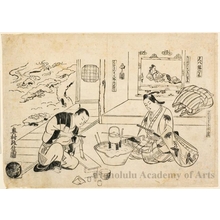
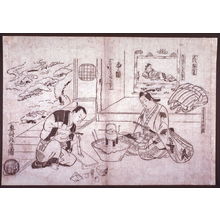
Estampe japonaise "Flageolet of a Potted Tree (Shakuhachi hachi-no-ki)" par Okumura Masanobu
Artiste :Okumura Masanobu
Titre :Flageolet of a Potted Tree (Shakuhachi hachi-no-ki)
Date :1710s
Détails :Plus d'informations...
Source :Worcester Art Museum
Parcourir toutes les 3 039 estampes...
Description :
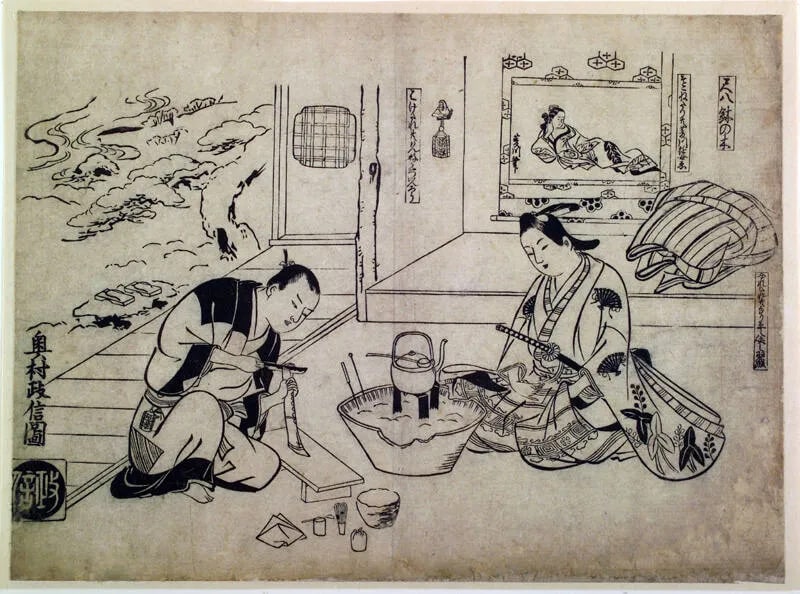
This is a mitate (playful transposition) of the legend and No play "The Potted Trees" (Hachi-no-ki) in which Sano no Genzaemon, who had been despoiled of his wealth and lived in the country in reduced circumstances, cut down his greatest treasure, the three potted bonsai trees (bamboo, pine and plum) which were his greatest treasure, to warm the room for a traveler who sought shelter on a cold night. The traveler proved to be the former regent (Shikken) Hojo Tokiyori (first half-middle of the 13th century; 1226?-1263?), who traveled incognito in order to see to the needs of his people. In this print an impoverished man dressed in patched clothes splits his shakuhachi (flageolet or wooden flute) as firewood to make tea for a handsome, and elegantly dressed young visitor. In the tokonoma are evidences of the man's earlier, more prosperous days. At the right is a coat labeled "Even though torn Narihira had a coat of Hachijo silk" (Yaretaredomo Narihira Hachijo no haori). In the center hangs a kakemono signed "brushed by Hishikawa" (Hishikawa hitsu) and labeled: "Even though damaged.a Hishikawa courtesan picture" (Soko netaridomo Hishikawa yujo-e). On the wall on the left hangs a lacquer inro, "Even though peeling, an inro by Kenko" (Hagetaredomo Kenko ga hitotsu inro).