Estampe japonaise "The Mountain House of the Kyōgoku Clan (Kyōgoku-ke no sankyo)" par Utagawa Toyonobu 歌川 豊宣
Artiste :Utagawa Toyonobu 歌川 豊宣
Titre :The Mountain House of the Kyōgoku Clan (Kyōgoku-ke no sankyo)
Date :1883
Détails :Plus d'informations...
Source :Worcester Art Museum
Parcourir toutes les 3 039 estampes...
Description :
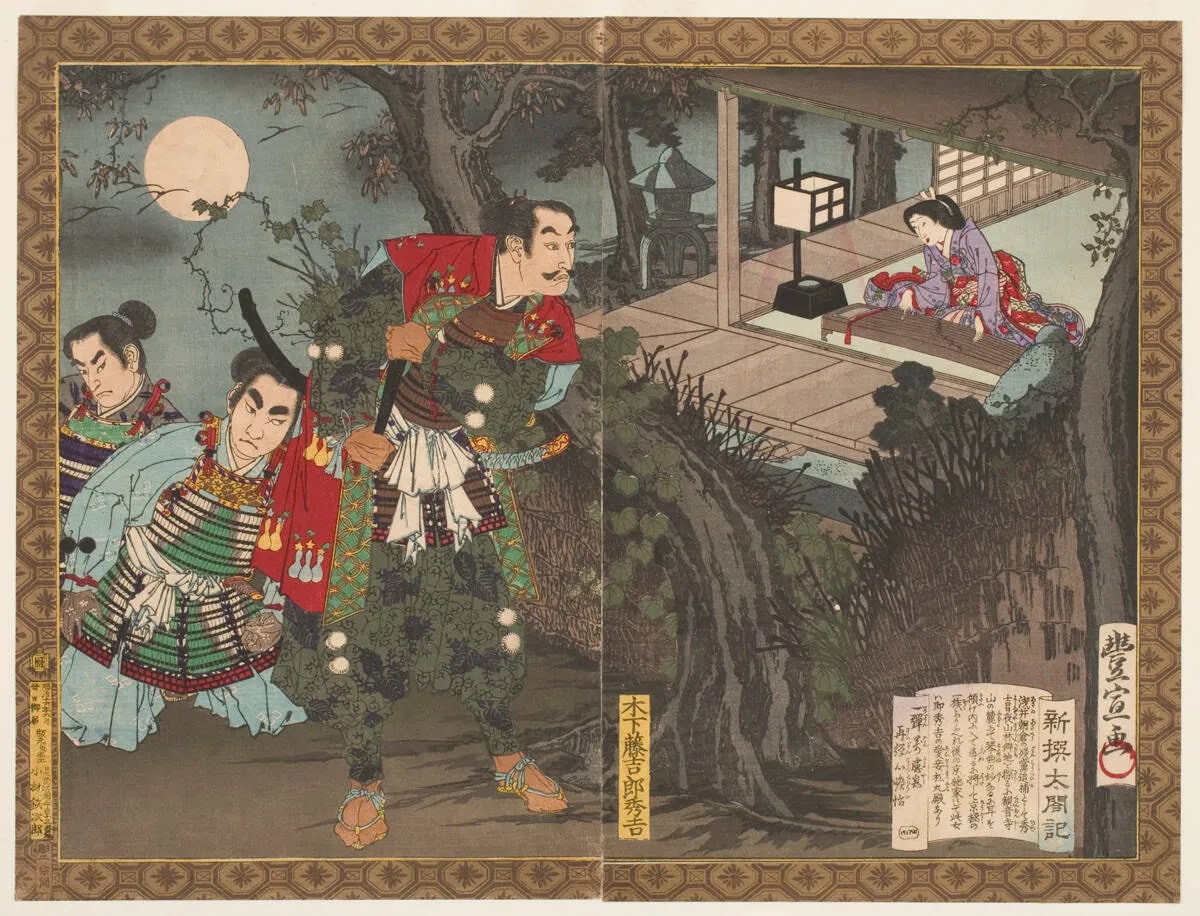
Born in 1538, as the son of a peasant-footsoldier from a village in Owari province, Toyotomi Hideyoshi was the loyal vassal of Oda Nobunaga. By consistently showing political cunning and strategic skills during military campaigns Hideyoshi eventually assumed the mantle of Nobunaga and became a powerful warlord. By 1591 he had brought order to the country, becoming the second of "the three unifiers." The print cartouche describes an episode from the biography of Hideyoshi (Taiko-ki). As a young man [then named Kinoshita Tokichiro], Hideyoshi was asked by Nobunaga to pursue enemies of the Asai and Asakura clans, "searching for them even in remote places." One autumn night, "at the mountainous base of Kannon-ji temple, Hideyoshi heard mysterious koto music." The poem reads: "One plucked string soothes a myriad thoughts, a second fills the heart with unending joy." The beautiful musician became Hideyoshi's third mistress, Matsumaru-dono. Hideyoshi wears a campaign coat decorated with a gourd design. Having no standard during his campaign against the Asai, Hideyoshi plucked a gourd and hung it upside down on the tip of a pole. Upon victory Hideyoshi believed in the power of the gourd and made it his emblem. He vowed to add a gourd for every new victory in order to symbolically create a "one thousand gourd" standard (sennaribyotan).