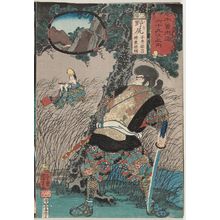
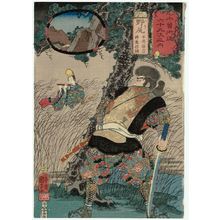
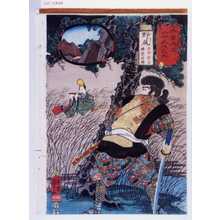
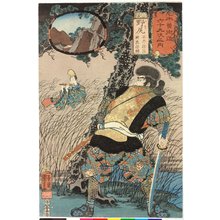
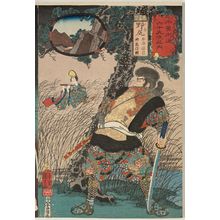
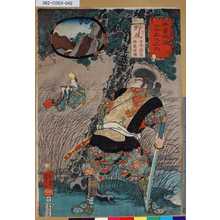
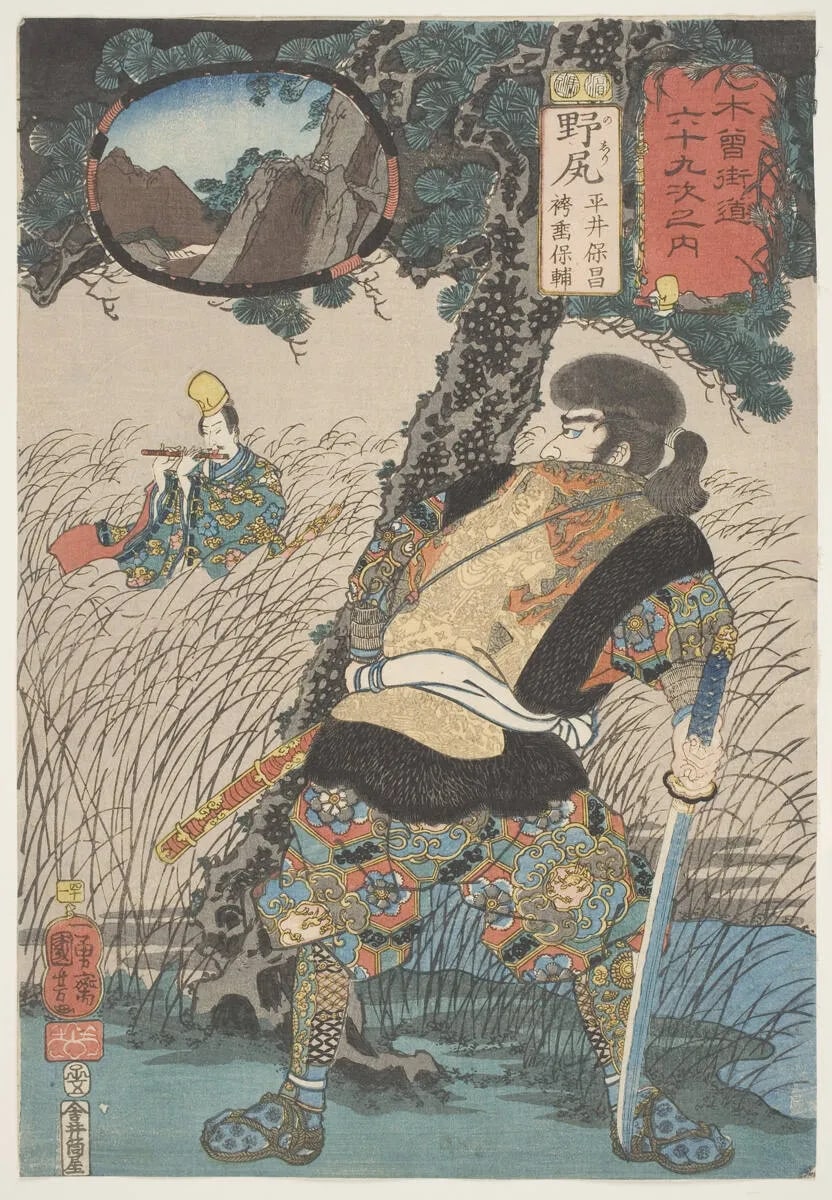
Estampe japonaise "Nojiri: Hirai Yasumasa Playing the Flute and Hakamadare Yasusuke Hiding with Drawn Sword Behind a Pine Tree (Station no. 41 from the series "The Sixty-Nine Stations along the Kisokaido")" par Utagawa Kuniyoshi
Artiste :Utagawa Kuniyoshi
Titre :Nojiri: Hirai Yasumasa Playing the Flute and Hakamadare Yasusuke Hiding with Drawn Sword Behind a Pine Tree (Station no. 41 from the series "The Sixty-Nine Stations along the Kisokaido")
Date :1852
Détails :Plus d'informations...
Source :Worcester Art Museum
Parcourir toutes les 3 039 estampes...
Description :
Yoshitoshi’s teacher, Utagawa Kuniyoshi (1797–1861), was a prolific and popular designer of warrior imagery. Many print series catalogued the rest stations along the five major highways connecting the capital with the rest of Japan. The Kisokaidō road linked the cities of Edo (Tokyo) and Kyoto, and like in many other series, Kuniyoshi paired historical events with landscape along the highway. Hakamadare and Yasumasa appear with the winding mountain road near the town of Nojiri. Hakamadare’s jacket is decorated with a design of the Buddha, in keeping with theatrical versions of the story. His hairstyle also is in the conventional style used for roguish characters.Label Text: Yoshitoshi’s teacher, Utagawa Kuniyoshi (1797–1861), was a prolific and popular designer of warrior imagery. Many print series catalogued the rest stations along the five major highways connecting the capital with the rest of Japan. The Kisokaidō road linked the cities of Edo (Tokyo) and Kyoto, and like in many other series, Kuniyoshi paired historical events with landscape along the highway. Hakamadare and Yasumasa appear with the winding mountain road near the town of Nojiri. Hakamadare’s jacket is decorated with a design of the Buddha, in keeping with theatrical versions of the story. His hairstyle also is in the conventional style used for roguish characters.