Estampe japonaise "Playing Battldore and Shuttlecock at New Year" par Ishikawa Toyonobu
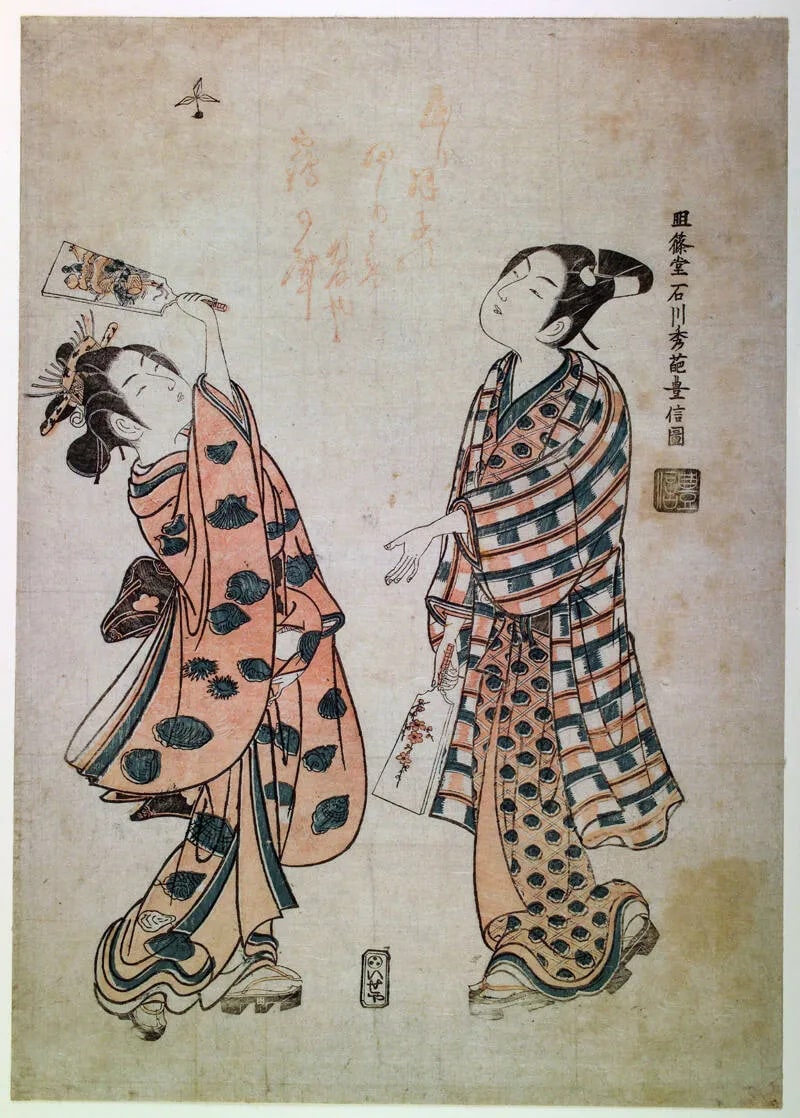
Artiste :Ishikawa Toyonobu
Titre :Playing Battldore and Shuttlecock at New Year
Date :1750s
Détails :Plus d'informations...
Source :Worcester Art Museum
Parcourir toutes les 3 039 estampes...
Description :
A girl and a youth playing hanetsuki (battledore and shuttlecock) which was a customary New Year's Day diversion for young people. They stand facing one another, both looking up at a shuttlecock which is in the air above the girl's head and which she is ready to strike with her battledore as soon as it comes within reach. Both battledores have appropriate New Year decorations: one the youth's a branch of kobai (red-flowered plum-a familiar reference to young male charm); on the girl's, symbolic treasures, most of them associated with the Seven Gods of Good Fortune (such as the wish-granting jewels [hoju no tama); a wide hat and straw raincoat which rendered the wearer invisible in order do good deeds without being seen or to escape from thieves (kakure-gasa and kakure-mino); an inexhaustible coin-purse (kane-bu) Toyonobu drew inspiration for his work from multiple other ukiyo-e artists, including Okumura Masanobu (1686–1764), who also has a print on view in this gallery. Additionally, the impassive faces and delicate yet expressive gestures of his figures suggest that he was emulating the oeuvre of the Kaigetsudo school of art, which reached peak popularity around the time he was active. The highly stylized forms set against negative space seen here are typical of Toyonobu’s mature style. The subject is a pair of young people playing hanetsuki (in English, battledore and shuttlecock), an activity similar to badminton. They stand facing one another, their eyes on the airborne hane. This image was probably created in celebration of New Year’s, indicated by the symbols on both paddles associated with the holiday—red-flowered plums and treasure connected to the Seven Gods of Good Fortune.